Overview
Affinity Home Care is a skilled home care and private-duty nursing provider serving the Hamptons, Long Island, Queens, and the greater New York metro area. They partnered with Elite Strategies in late 2025 to strengthen their digital presence in a highly competitive YMYL (Your Money or Your Life) vertical, improve E-E-A-T signals, and grow non-branded organic visibility for high-intent service and location queries. The engagement started with a manual SEO audit that surfaced thirty-plus on-page and structured-data issues holding back AI Overview eligibility.
Industry
Home Health Care & Skilled Nursing (YMYL vertical)
Platform
WordPress (Avada) + ACF + Custom JSON-LD Schema Graph
Project Goal
Establish the client as a clear, trustworthy entity across every region served and grow non-branded visibility on service + location queries.
The Challenge: Ranking a Home Care Brand in 2026
Ranking a home care brand in 2026 is not a normal SEO project. Every page on the site touches human health, so Google applies the strictest YMYL quality bar it has. On top of that, generative AI systems (AI Overviews, Gemini, ChatGPT Search, Perplexity) now act as a second gatekeeper: if your content is not cleanly parseable, entity-aligned, and semantically unambiguous, you are simply left out of the summary.
When we audited the site, the fundamentals were not there yet:
The net effect: Google had no reliable way to verify who this home care business was, what they actually did, or where they did it. AI crawlers had even less.
Our Solution: Three SEO Pillars for AI-Era Visibility
We rebuilt the site’s content architecture around three pillars that matter disproportionately in 2026: entity clarity, E-E-A-T, and machine-readable structured data. The work touched every service page, every location page, and the entire schema graph.
1. Rebuilt Service Silos With Clinical Precision
Every core service was broken out into its own deep, standalone page: Ventilator Care, Tracheostomy Care, Private Duty Nursing, CPAP / BiPAP Support, Dementia & Alzheimer’s Care, Post-Surgical Recovery, and Pediatric Home Nursing. Each page was structured around the language clinicians actually use, with a clear definition, the conditions it addresses, the credentials of the caregivers who deliver it, the equipment and protocols involved, and the care settings it covers. This gave Google explicit topic boundaries and gave AI systems a clean block of text to quote.
2. Location Pages Rewritten as First-Class Entities
Instead of a single page per town with the service list swapped in, we rebuilt each location page as a genuine local entity: specific coverage radius, named townships served, local intake phone, licensing jurisdiction, county-level Department of Health references, and a unique narrative about care delivery in that community. Hamptons, Suffolk County, Nassau, Queens, and the Long Island corridor each got their own treatment.
3. E-E-A-T, Stated Explicitly
We added named clinical reviewers with licensure (RN, LPN, CNA credentials, state license numbers), editorial review dates, an About page that reads like an actual organization (founding year, leadership bios, accrediting bodies, insurance affiliations), and clear “Reviewed by” bylines on every clinical page. These are the signals human quality raters (and by extension, Google’s scoring systems) are trained to look for on YMYL pages.
4. Custom JSON-LD Schema (Where Most of the Lift Came From)
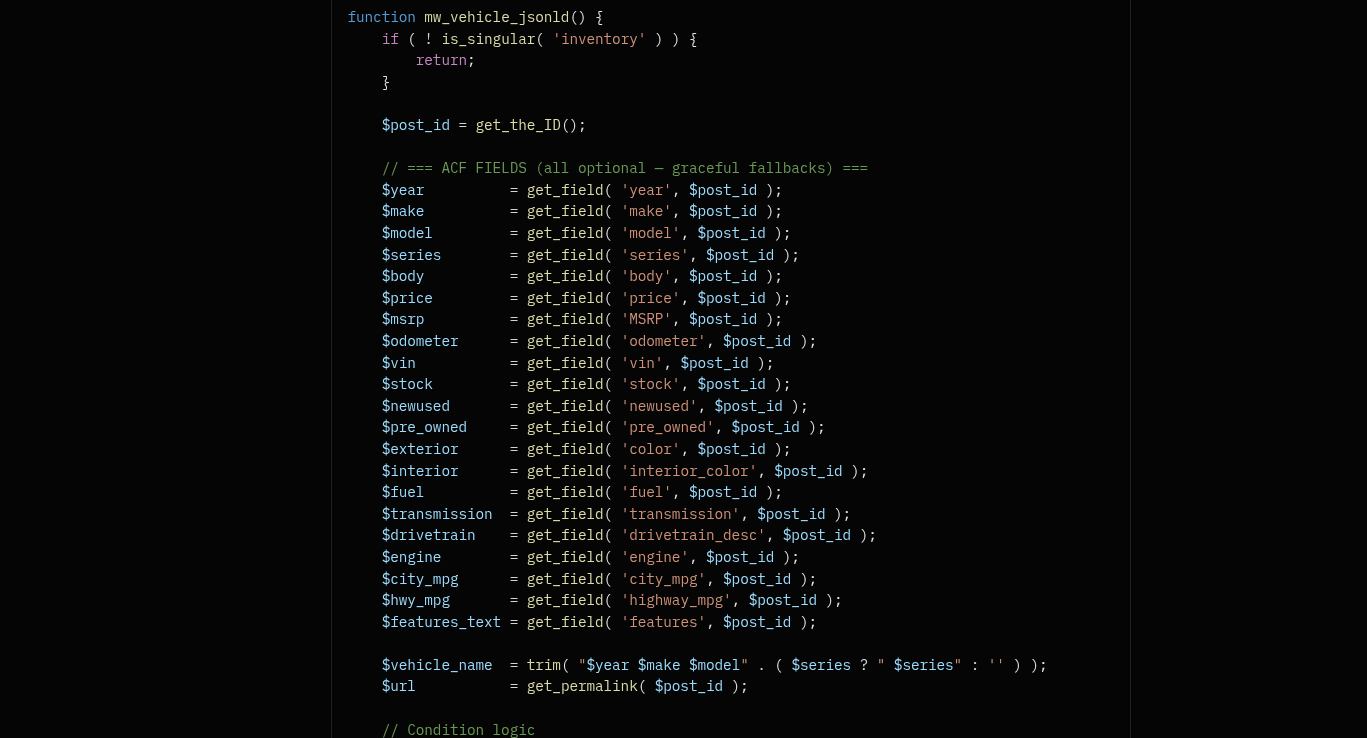
We replaced Yoast’s default schema with a hand-authored JSON-LD graph delivered through a custom ACF-backed field on every page. This is the same approach we used on our dynamic vehicle schema case study, adapted for the MedicalBusiness vertical. Each node in the graph was explicitly linked by @id so Google could traverse the organization → location → service → reviewer relationships as a connected entity graph rather than isolated blobs. The graph included:
All of it validated cleanly in Google’s Rich Results Test and Schema Markup Validator, with zero errors and zero warnings.
Results: Cited in Google AI Overviews
Within weeks of the rebuild going live, we started seeing the signals SEO teams look for before rankings follow: non-branded impressions climbing, new long-tail queries entering Search Console, and the first AI crawler hits (GPTBot, PerplexityBot, Google-Extended) picking up the updated pages.
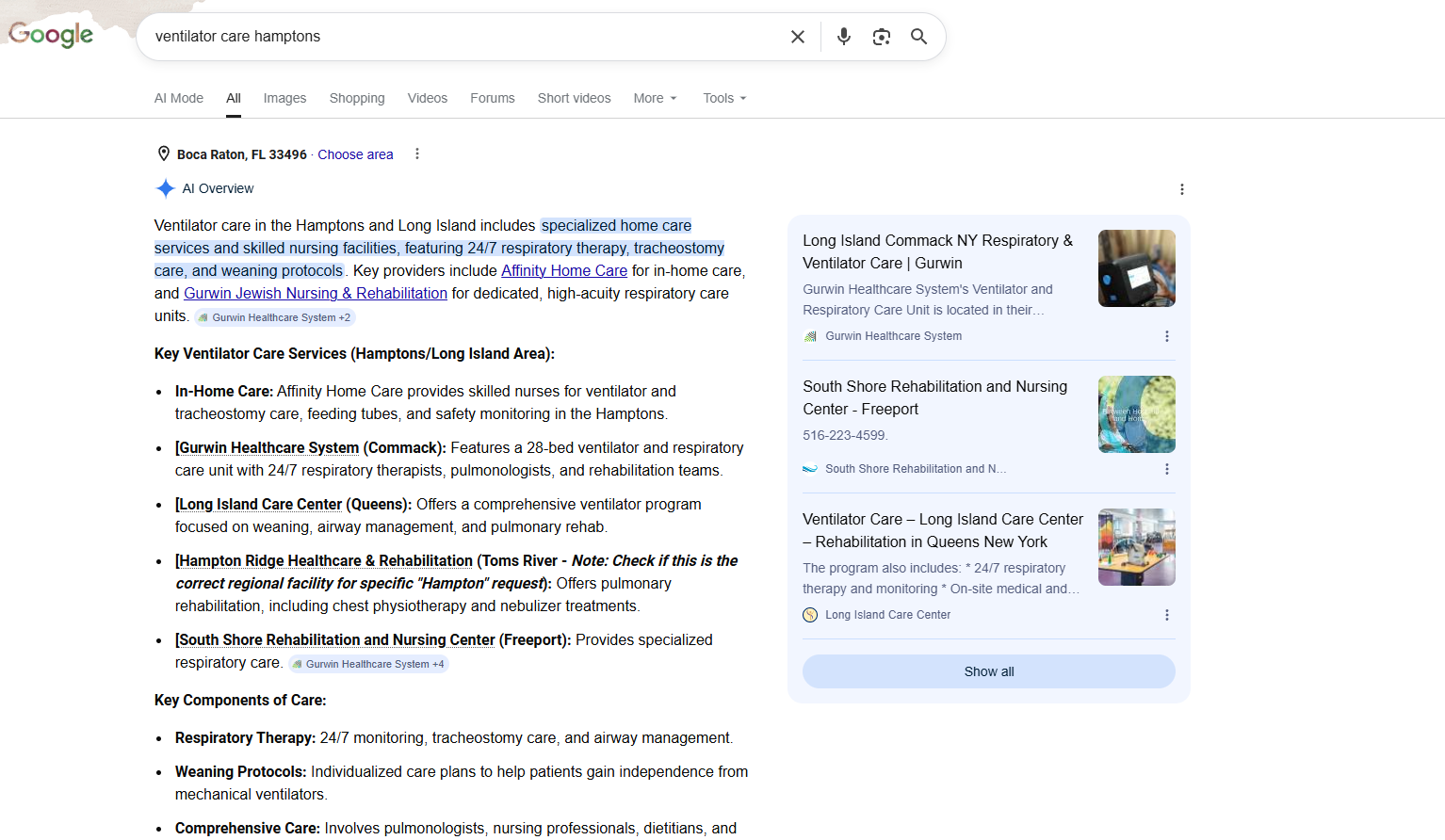
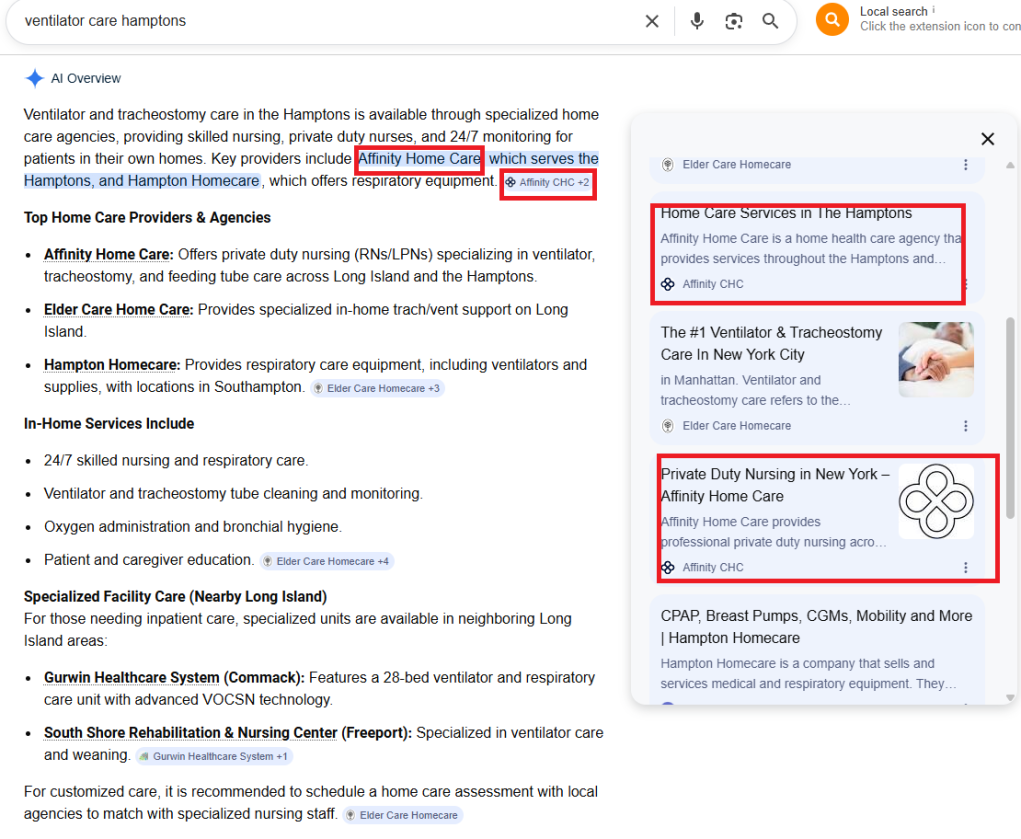
Then the bigger signal came in. Google’s AI Overviews began citing Affinity Home Care by name for service + location queries, including the high-intent YMYL query “ventilator care hamptons.”
For a YMYL provider, getting cited in an AI Overview is meaningfully harder than ranking #1 in classic blue links. Google’s systems have to decide that your entity is trustworthy enough to speak on a health topic to a consumer. That does not happen by accident. It happens when the structured data, the on-page E-E-A-T, and the topical coverage all reinforce the same signal.
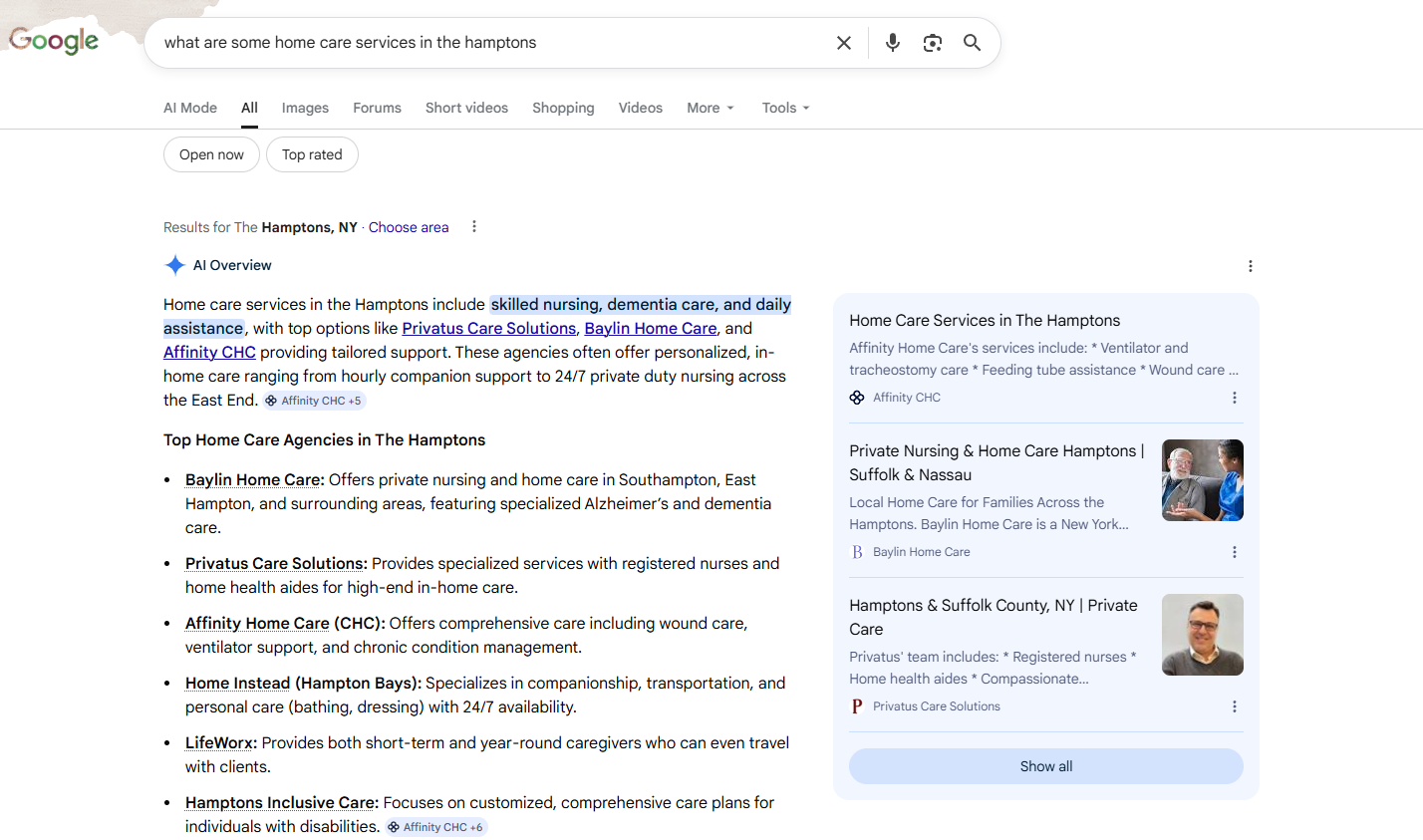
We saw the same behavior across related queries. Searches like “home care services in the hamptons,” “top home care providers hamptons,” and additional service-plus-location variants all started surfacing the client inside the AI Overview module:
Early Measurable Wins
These are the earliest signals that Google and AI crawlers are fully parsing and recognizing the rebuild. Based on the pattern we see with similar YMYL rollouts, we expect continued expansion across additional care-based queries over the coming months.
Why This Matters for YMYL SEO in 2026
Two things have shifted. First, AI Overviews are eating the top of the SERP for informational and comparative health queries, which are the same queries that used to drive home care lead volume. Second, Google’s systems trust structured data far more than they trust prose claims. If your site says it has RNs on staff but your schema graph does not model them as Person nodes with credentials, you are leaving the strongest expertise signal on the table.
This project is a clean example of how those two shifts interact. The JSON-LD graph told Google precisely what the business was. The E-E-A-T rebuild told Google why it was credible. The service and location silos told Google where it was relevant. AI Overview citations were the natural output of all three pointing in the same direction.
Conclusion
Winning in a YMYL vertical in 2026 is less about publishing more content and more about making the content you have unambiguously legible to Google’s entity systems and to every AI crawler that now sits alongside them. Clean service silos. Location pages that are real entities. Named, credentialed reviewers. A JSON-LD graph that actually models the organization instead of decorating it. Do those four things well and AI Overview citations stop being a lucky break. They become the expected result.
Need AI Overview Ready SEO for a YMYL or Local Service Brand?
Elite Strategies has been doing technical SEO, structured data, and content architecture for regulated and YMYL industries for over a decade. If you want a second opinion on why your service or location pages are not being picked up by Google’s AI systems, or you want a rebuild that is, reach out.