
Google Business Profile Refresher
2026 Update – This course started life in 2020 and the fundamentals still hold, but a lot has shifted since our last refresh. Google killed GBP chat and call history in July 2024, shut down the free GBP-built websites in March 2024, and officially retired the Q&A feature in late 2025 in favor of an AI-powered “Ask Maps.” AI Overviews and AI Mode are now a real source of local traffic, and Google’s automated enforcement has turned a lot of previously fine listings into suspended ones. The backend dashboard that single-location businesses used to love is almost entirely gone – nearly everything happens on Google Search and Google Maps now. Here’s what still matters in 2026, and what you should stop worrying about.
We wanted to make a refresher course for people that might be new to Google My Business, Google Business Profile or old school SEO’s that might need to brush up on their Google Business Profile skills. GBP fluency is something we expect from everyone on our SEO team, since local pack visibility is often where the call volume actually lives for small business clients. The one thing we won’t cover in this course is signing up / verifying your GBP listing. This post assumes you already have your GBP setup and verified.
If you are looking for any type of black hat secrets for GBP I’m sorry to say this is not the place for it. I’ve learned quickly in my SEO career that while some of these tactics may work, they aren’t viable for businesses that are in it for the long haul. Almost always, they end up backfiring. I will however offer some tricks and insights I’ve learned optimizing Google Business Profile listings for the past decade or more.
So let’s go!
Table of Contents
What is Google Business Profile?
If you’ve gotten this far I’m sure you already know this, but Google Business Profile, or “GBP” for short amongst us SEO’s is a free tool provided by Google that lets you manage how your business looks on Google Search and on Google Maps. Google Business Profile can be used by business owners to manage their own listing, or shared by business owners and their agencies by sharing management access to the accounts.
The evolution of Google Business Profile has been almost constantly changing since its inception in the early days of Google Places, and later Google+. It seems as though Google has finally found there footing with their naming convention.
Do I really need Google Business Profile?
If you have a location where customers come to visit, yes. If your customers do not visit your location then then you still may want to have a Google Business Profile listing. I personally like to peek at what local competitors are doing and follow suit. If you are a brand new business and aren’t sure, you can always wait a bit and open a Google Business Profile listing later.
AI Overviews, AI Mode & GBP in 2026
This might be the biggest change in local search since the launch of the Knowledge Panel. Google’s AI Overviews (the generated summary block at the top of search results) now appear on around 40% of all queries and roughly 7% of local queries. “AI Mode,” the full conversational search experience launched in 2025, increasingly hands off intent to Gemini before a traditional map pack is ever rendered. Consumer behavior has shifted to match: industry surveys in early 2026 show that 45% of consumers now use AI tools to find local businesses, up from 6% one year prior – a 650% jump.
What changes for your GBP strategy?
- Completeness is worth more than ever. Profiles filled out entirely (hours, services, categories, attributes, description, photos) appear roughly 18x more often than sparse profiles, and they’re the ones Gemini will actually cite.
- Reviews are now training data. Both AI Overviews and Ask Maps pull phrases and summaries directly from your Google reviews. Encouraging detailed reviews (not just star ratings) pays off here.
- Post frequency became a ranking signal. Accounts that post 1-2 times per week consistently outperform dormant ones. Sitting idle for 30+ days can measurably drop your impressions.
- Distance matters less in AI answers. Unlike the traditional local pack, AI Overviews don’t appear to weight proximity as heavily. A great profile further away can out-rank a mediocre nearby competitor in an AI answer.
- Your website still matters. Gemini uses the content of your linked website – especially FAQ pages, service descriptions, and location pages – to answer local questions. Keep your site crawlable and factual.
Bottom line: GBP is no longer just about “show up in the map pack.” It’s about giving Gemini enough accurate, structured, recent information to confidently mention you when someone asks an AI a local question.
Google Business Profile Basics
The name of the game with Google Business Profile basics for optimization is filling in all of the blanks with attention to detail, this includes at the very least:
- phone number
- address
- hours of operation
- website
- description
- category
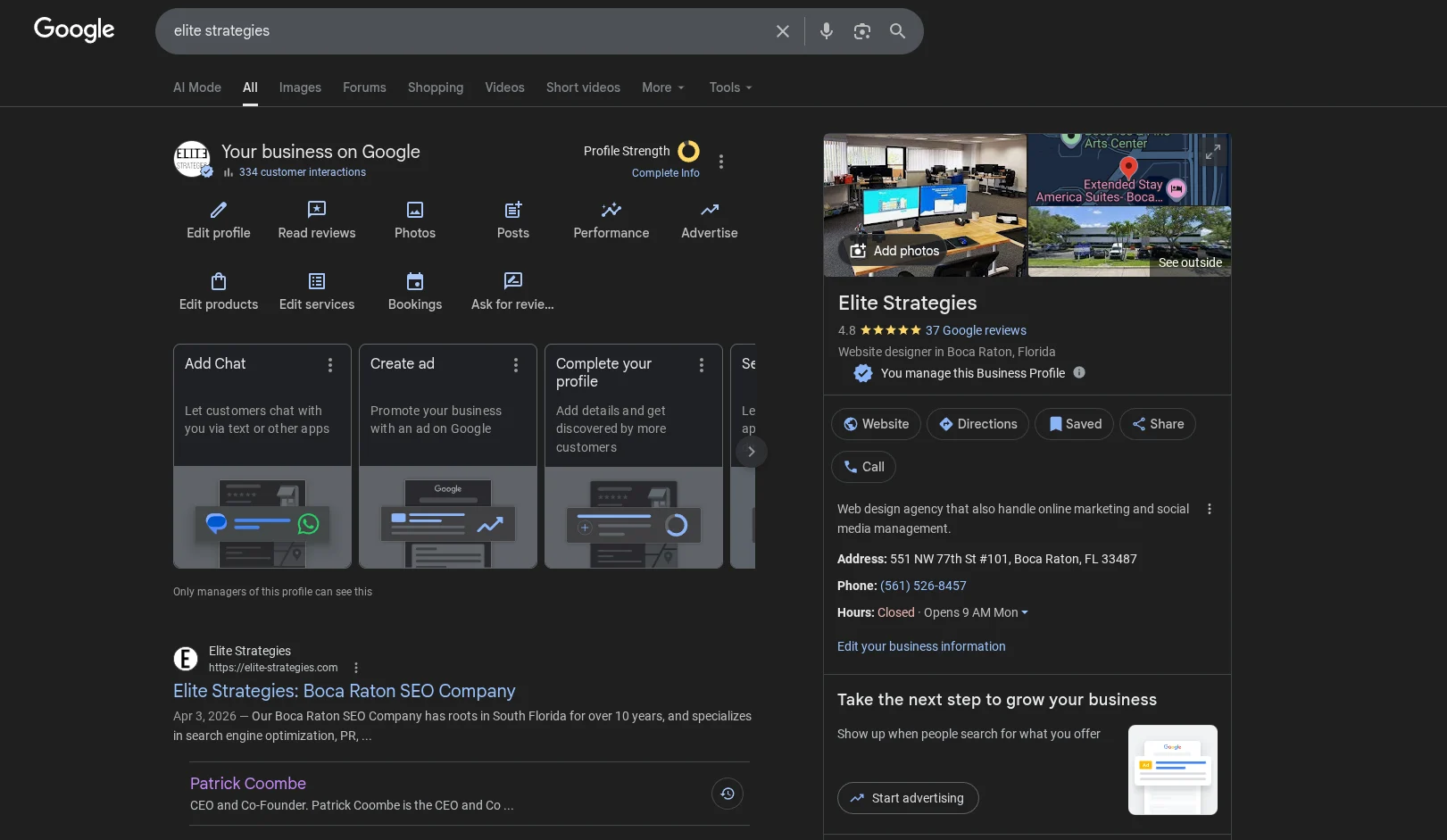
Here is a birds eye view of the GBP dashboard on desktop:
2026 Update: The classic GBP “dashboard” is effectively dead for single-location businesses. Everything – hours, services, photos, posts, reviews – is now edited directly from your own business listing on Google Search or Google Maps when you’re signed in as the owner. Multi-location brands and agencies can still use the Business Profile Manager for bulk edits, but Google has been pushing even those accounts toward front-end editing. For the purpose of this post we’ll show the front-end “edit profile” flow, since that’s what the vast majority of readers will see.
Phone Number & Address
Pretty self explanatory. You definitely want to use your main company phone number, you can also add a 2nd phone number such as an 800 number, customer support number etc. Same with address, make sure that the address is filled out in its entirety. If you’d like, you can add a call tracking number which we will talk about later in this course.
Hours of Operation
Fill in your hours of operation. If you are a 24/7 business indicate it there as well. If you’d like, you can add special holiday hours as well. Google will generally send you a reminder a few days or maybe a week before major holidays to let you know to inform your customers about holiday hours.
Website
Obviously a key ingredient in your GBP listing. Ideally your customers won’t dwell on Google for too long, and will click your website to learn more about your company. Most of the time you should just use your base URL, some companies make a special Google Maps style landing page.
Description / Information
Another very key ingredient. You only get 750 characters (about 8-12 sentences) so make it count. Be sure to add location specific keywords, but resist the urge to stuff keywords into this section, try to be natural. Take a step back from your marketing role and put your customer hat on for a second. What do your customers want to see when they look at your GBP listing? Personally I like to write a custom GBP elevator pitch for each one of my listings. Remember that after a few sentences your description gets cut off, so make the first few sentences count.
Category
Choose a category of your business. You can start typing and it will make suggestions, or you can choose from this massive list that I found floating around on the web. You can add several categories if you want. For instance if you are a pet store, but you also do dog grooming you can add “pet store” and “pet groomer.” Choose wisely, and as GBP says inside the dashboard: “Categories describe what your business is, not what it does or sells.” Kind of cryptic, but it makes sense if you think about it.
Once you are sure that all of these fields are filled out and showing up on Google, you can start working on the more advanced fields such as services, highlights, and photos.
If you’ve only taken one thing away from this course so far, fill out all of your information in Google Business Profile with as much detail and accuracy as possible.
Knowledge Panel
When searching for a business on Google.com, the area to the right of the search results is known as the “knowledge panel.” Knowledge panels are a collection of information taken from both Google Business Profile and other sources from around the web.
Take this example below, the address, hours, phone number and website are all taken directly from Google Business Profile information. “Reviews from around the web” are taken from, as you may have guessed, reviews from other sites on the internet.
Like most aspects of Google search engine, different businesses have different types of knowledge panels. Some knowledge panels are tiny bits of basic information, other knowledge panels contain droves of information about a company.
Did you know Google will send you free “review us on Google” stickers for your business? Just navigate to this link, enter your business information, and they will send you a pack of stickers.
2026 Update: Google stopped mailing physical stickers years ago. The Marketing Kit at marketingkit.withgoogle.com still lets verified owners download printable posters, social posts, and “review us on Google” stickers for free – you just have to print them yourself (or send the files off to a local printer like Vistaprint). Worth noting: the Marketing Kit has quietly disappeared for some users in late 2025, so if the URL doesn’t load for you, Google may have pulled it again in your region. Don’t assume it’ll stick around forever.
Google Business Profile Photos
Adding Photos to Google Business Profile
Google has pretty much stated outright that adding photos to your GBP listing will increase visibility. Like most aspects of Google Business Profile, quality > quantity. Your photos should all be photos of your business, your team, and your office. Do not use stock photos or screenshots, while they might get approved and added to your business they may get removed or flagged in the future.
Try to upload a mix of interior, exterior, and team shots so customers can see a variety of different photos of your business.
Types of GBP Photos
- interior photos – photos of the inside of your business
- exterior photos – photos of the outside of your business
- product photos – photos of your company products, these can be professional lightbox photos or amateur photos
- at-work photos – photos of your staff in action
- food & drink photos – special designation normally reserved for restaurants and coffee shops
- common area photos – special designation normally reserved for hotels and similar establishments
- rooms – special designation normally reserved for hotels and similar establishments
- team photos – photos of your staff members at work, this can be a few of them in a small group or a whole company shot
2026 Update: GBP now displays a practically endless number of photo sub-categories, and most of them are auto-generated by Google’s image recognition (increasingly Gemini-powered). Compare a busy restaurant listing to a small service business and you’ll see the restaurant has dozens of buckets – “food,” “drinks,” “menu,” “vibe,” “vegetarian options,” “desserts,” and on and on. You don’t pick these categories yourself; Google tags them for you based on image content. The practical takeaway: the more varied (and accurately captioned) your photos, the more ways Google has to surface your listing in image-heavy queries and AI answers.

Google Business Profile Cover and Logo
When Google Business Profile added the “logo” feature a little while back, I was a bit puzzled. None of my listings seemed to “work.” Meaning, I would add logos, Google would “accept” it but they would never appear on the Google knowledge panel. Shortly after I discovered that the logo really only shows up on mobile. So if you are looking for your logo on desktop, you probably won’t find it. I checked 5-10 other businesses with very optimized listings and confirmed this.
The logo is a tiny icon that appears right justified to the official name of the business on a GBP listing. The cover is quite simply, a header image that sits at the top of your listing.
Note: just because you designate a logo or a cover image, doesn’t mean Google will use that image in the knowledge panel / search results.
In fact, I would say that most of the GBP profiles I come across have a different cover image than the one they choose. You can increase your chances of getting your cover image chosen by using a high quality image.
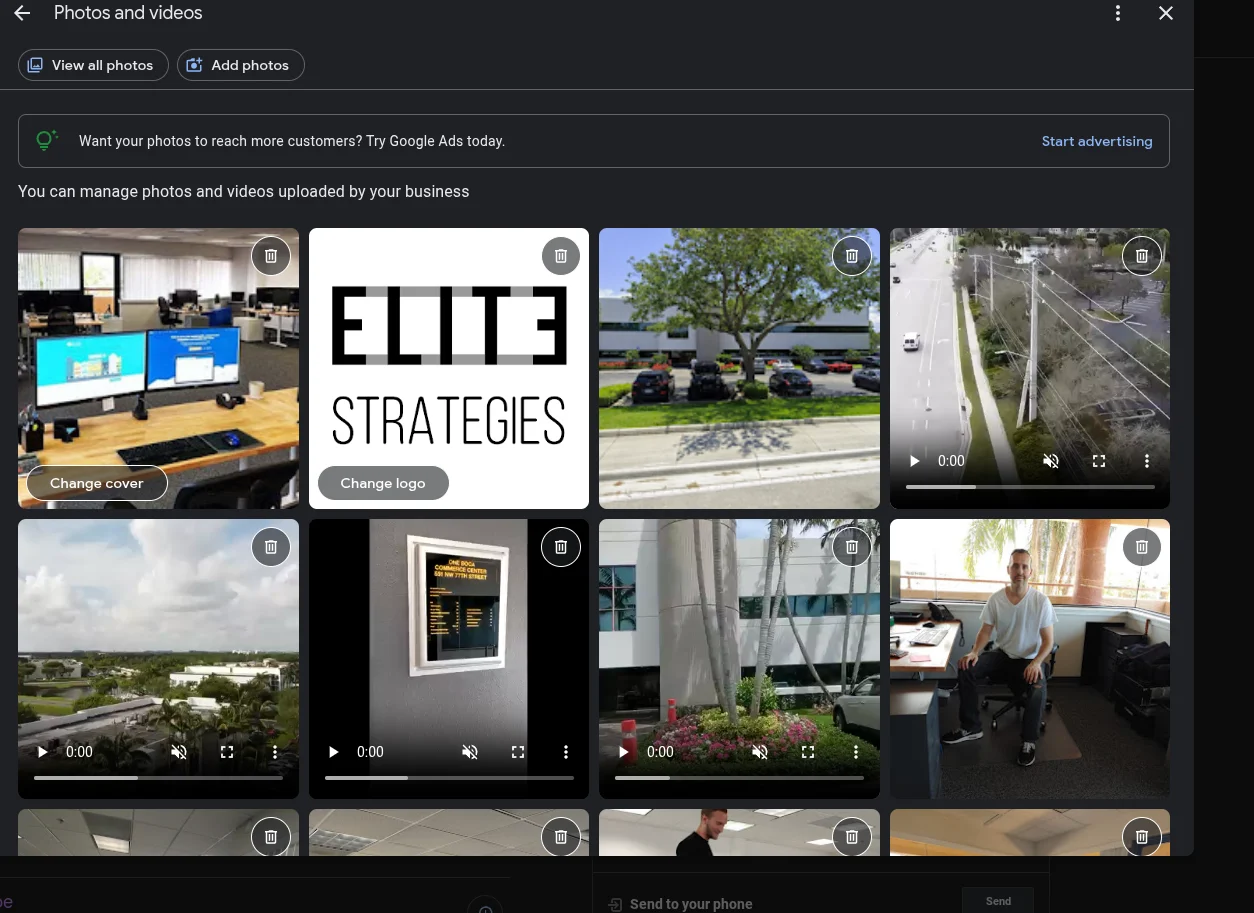
What do I do if an ugly photo is showing up as my cover image?
We’ve had this happen recently. A customer uploaded a random photo to a clients GBP profile, and for some reason Google started using it as the cover image. In our case we first were able to get the photo removed. We then re-uploaded a new high quality photo and re-designated it as the cover image. Usually the best case scenario is that Google will use the photo you chose, the worst case is it will use another random photo.
Good practice: Always act as if every photo you upload to Google Business Profile may be used as your cover photo.
Google Business Profile Photo Guidelines
Google has kindly given out some photo standards, which are fairly easy to live by. Your photos will look best on Google if they meet the following standards, taken directly from Google:
Image / Photo format: JPG or PNG (sadly Google doesn’t say anything about their own image format WebP, but I haven’t tried either. )
File Size: Between 10 KB and 5 MB.
Minimum resolution: 720 px tall, 720 px wide. (I’ve found that square aspect images work best, but both horizontal and vertical rectangles work great also)
Quality: The photo should be in focus and well lit, and have no significant alterations or excessive use of filters. In other words, the image should represent reality.
Customers love to look at photos before they come to your place of business, especially places like hair salons, restaurants, and coffee shops.
Myth: Does exif data in GBP help my rankings?
Probably not, maybe…I don’t know. Someone on reddit claimed to debunk this at one point. Maybe it helped at one point in the past, maybe it will help in the future. Bottom line: if you have the time and want to do it, it really can’t hurt you to add exif data to your photos in Google Business Profile but I would really lower your expectations. The whole theory behind this is that by adding exif location data to your photos, GBP’s algorithm would “give mad props” to photos that belong to the location that you are trying to rank for. While in theory this makes sense, it was probably just another SEO myth.
Removing Photos from Google Business Profile
Removing photos from Google Maps can be a bit tricky. If you uploaded the photos yourself, it is as simple as going to Google Business Profile Photos, locating the photo, and deleting it. If you don’t own the photo, flag it and chances are it will get removed. Just be sure to note “other” and say that it is either low quality, or duplicate. You don’t want to get someone in trouble.
Google Business Profile Videos
Adding videos to your GBP listing can definitely give your company an edge over your competition. There is one caveat for GBP videos: your videos must be “shot” at your place of business. Just like photos, you can’t use random videos from around the web, stock videos, or videos shot in a park or a mall. While your video may pass the initial upload test, it could get taken down or flagged.
taken from another website – However, for you marketers out there, there’s a catch. You need to make sure your videos are taken at the place of business, are of people that work at your business or directly pertain to your business. (Google Business Profile videos is no place for cheesy stock photos, stock videos or marketing bling videos.)
- Duration: 30 seconds
- Max video file size: 100 MB
- Minimum Resolution: 720p
Some examples of videos you might want to upload:
- show how your product is made e.g. pizza place showing how to make pizza
- employee interview with staff member working on a project
- a walkthrough of your office
- a company party or lunch
- sitting in on a company meeting
Google Business Profile Services
GBP Services are a new way to showcase your company services to your potential customers. It gives them a way to scroll through your services without having to call you or go to your website. Some people say this is more of a con than a pro, because you want customers to visit your website or call you so it is really a matter of opinion. Adding services is very easy using the GBP dashboard on desktop.
GBP services are useful for lots of different companies:
- local contractors, handymen
- hair salons and nail salons
- website designers and IT companies
- pest control companies
- many more
Once you are in the dashboard, you can see that services are separated by sections. For example, this hair salon has their services separated by eye brows, lashes, hair care, and more. Each section gives you the ability to add services underneath. Fill in as much information as possible, you don’t have to fill in the price or description but it is a good idea to do so.
Once you are finished, Google Business Profile should make your changes live relatively quick. It is easy to see your services live on mobile search:
Again, adding services is optional and more of a matter of opinion if it is helpful or not.
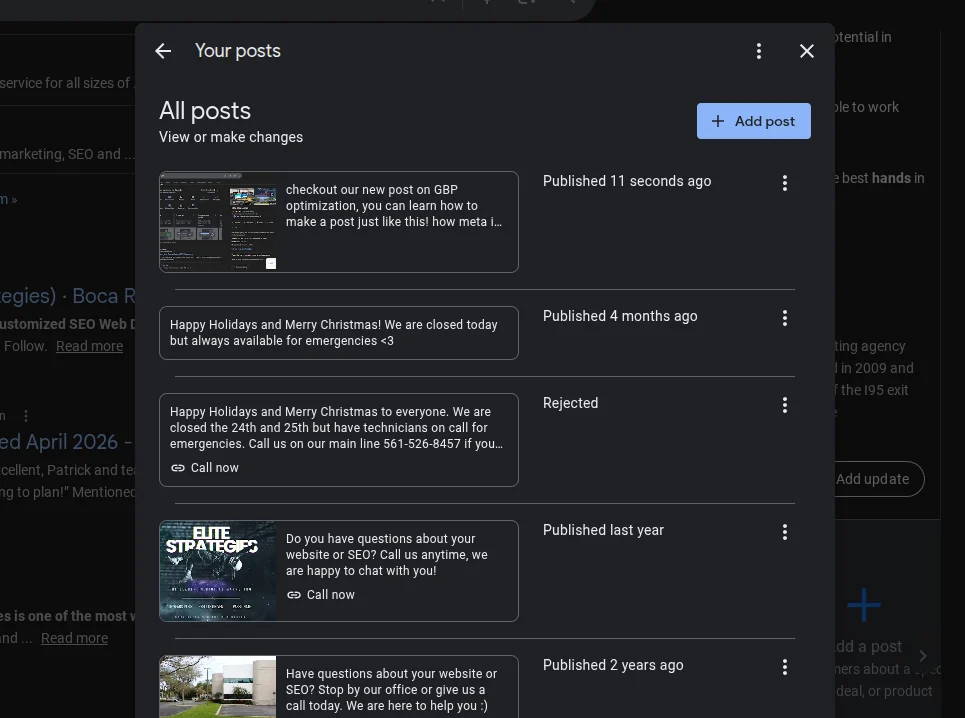
Google Business Profile Posts
Google Business Profile Posts are a hot commodity right now. They give you a way to extend your SERP real estate in a very visible way. It is like adding a 1/2 acre yard to your apartment.
There are 5 main types of GBP posts:
- what’s new – pretty self explanatory, a teaser post outlining a new offering at your company
- events – promote an event within your company such as a seminar or band playing at your coffee shop
- offers – buy 1 coffee get a free biscotti every Tuesday, mention “freeBiscottiTuesday” to redeem
- products – promote a product on your GBP listing
- welcome offer – (see below)
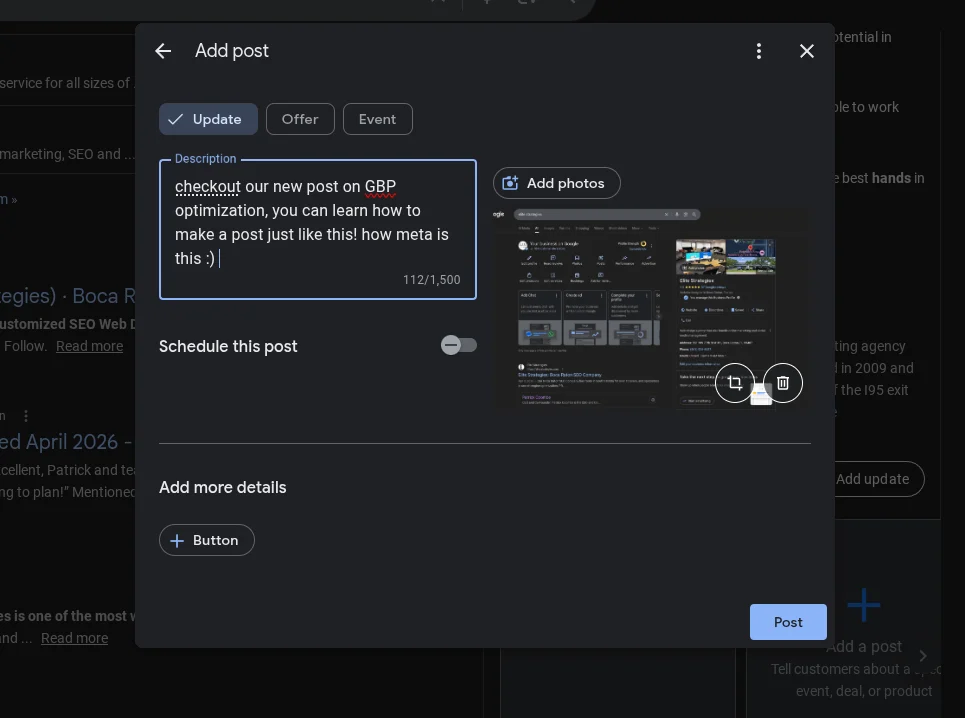
Creating a post is easy using the GBP app or desktop dashboard. Find the “posts” section within the dashboard, and click on either add update, event, offer, or product. Once you are there, it is pretty self explanatory:

GBP posts show up prominently on both desktop and mobile. Here you can see a local PR firm promoting a recent blog post on their panel.

The last time I was logged into GBP, Google gave me a few examples of “posts I might like” so I thought I would share them here. The first post is from a web designer, that chose to list their services in a vertical list. The second one showcases their blog posts with a “learn more” button. The 3rd company (a life coaching company) uses a nice call to action with a learn more button.
2026 Update: A few big things have changed with Posts:
- Post frequency is now a meaningful ranking signal. Multiple 2025-2026 studies have shown that profiles with at least 1-2 posts per week see materially better visibility than dormant ones. Accounts that go 30+ days without posting have reported sharp drops in impressions.
- Multi-location posting is finally here. Franchises, chains, and agencies can now publish a single post to every location at once from the Business Profile Manager instead of copy-pasting 40 times.
- Per-post insights are back, sort of. Google now reports Posts performance inside the unified Performance / Insights view on the front-end listing. It’s less granular than the old dashboard reporting but the data is there.
- Events and Offers with scheduling. You can now schedule Offers and Events to auto-publish and auto-expire on set dates.
Highlights / Attributes
Adding some GBP “flair” to your post can attract some attention. Just be warned there are all types of people out there. To some people a veteran owned / woman owned / LGBTQ friendly company is a great thing, for some people it is not. It is of my personal opinion that you should be proud of who you are, and never to compromise or hide that.
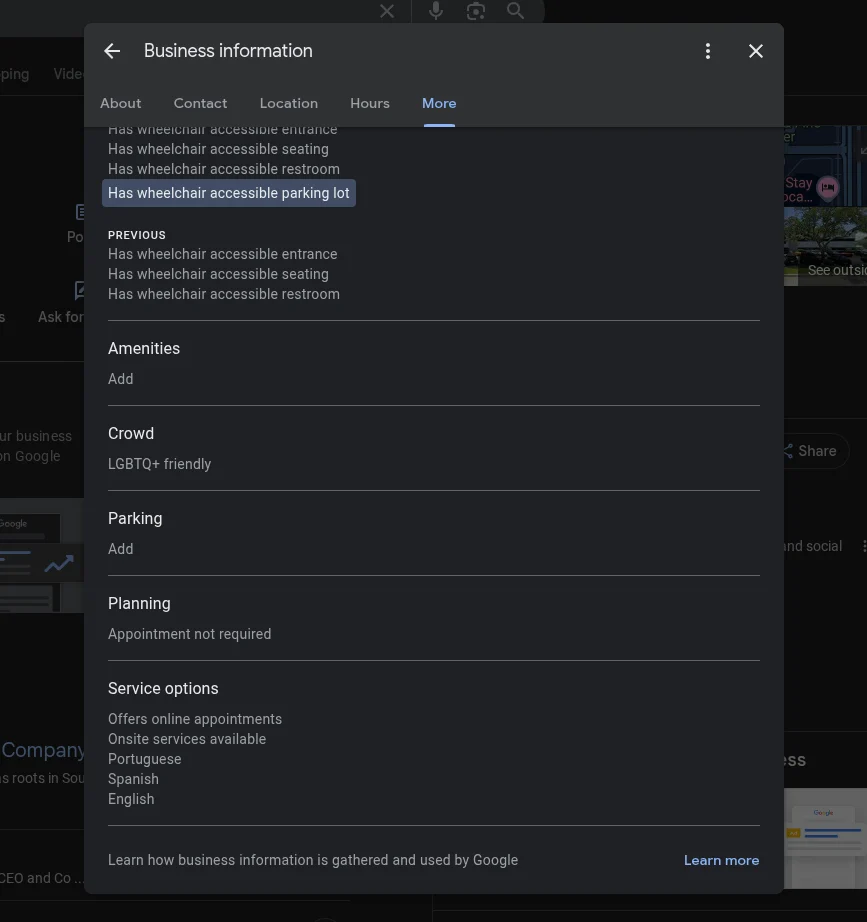
Adding amenities such as restroom, free WiFi and parking can also be very helpful to your customers.
Note: not all amenities and attributes are available to all businesses. At times there seems like there is no rhyme or reason to the attributes that you can add, and a lot of them are industry specific.
Adding attributes / amenities / highlights is as simple as going to the GBP dashboard and checking a few boxes. Be honest, if you don’t have an elevator or unisex restroom don’t say that you do.
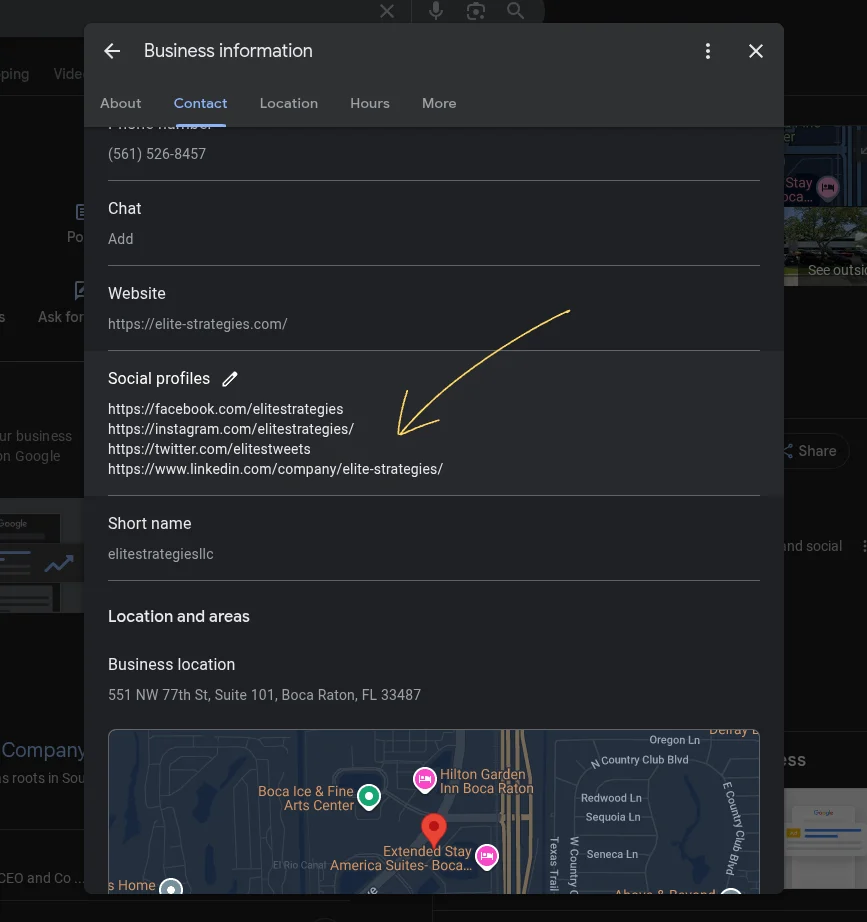
In 2024 Google quietly added the ability to link your social profiles directly to your GBP. By 2026 this is fully live for most accounts – you can add Facebook, Instagram, LinkedIn, TikTok, X (Twitter), YouTube, and Pinterest links that appear as clickable icons on your knowledge panel.
To add them, open your Business Profile on Google Search (signed in as the owner), click “Edit profile,” scroll to “Contact information,” and look for “Social profiles.” Paste the full URL for each network.
Why bother? Google uses these links as entity-verification signals – they help confirm that the business on GBP is the same business behind your social presence. It also adds one more click-through path for potential customers, and a well-maintained Instagram or TikTok can surface in Google image and short-video results tied to your listing.
Tip: only link accounts you actually maintain. A linked-but-dead social profile with zero posts from 2022 does more harm than good.
GBP Welcome Offers
GBP Welcome offers are a relatively new feature having just launched in late June 2019. GBP Welcome offers are essentially what I call an “expanded post.” It is a GBP post but it incentivizes people to follow you on GBP in exchange for an offer that you define.
I have noticed that the desktop version of GBP is slightly different from the app, and varies from account to account. On one account for instance, I could not see welcome offers at all. In most cases, Welcome Offers are more prevalently available on the mobile app than desktop, so in this example we will use the mobile app.
Adding a Welcome Offer is simple, it is just like adding a post except you need to add a promo code.
In most cases, your post will be live right away. In some cases you may need to wait for anywhere from a few hours to a few days. In the example I created for this post, it was live immediately. This is how it looks on Chrome mobile:
From Q&A to Ask Maps
The old “Questions & Answers” section – where anyone could post a question on your listing and anyone else (including you) could answer – was officially retired by Google in late 2025. The My Business Q&A API was shut off in November 2025, and third-party tools can no longer read or write Q&A content.
In its place, Google rolled out “Ask Maps,” an AI-powered feature that answers questions about a business automatically using:
- your complete GBP data (description, services, hours, attributes)
- the content of your reviews
- your linked website – especially FAQ and service pages
- other mentions of your business around the web
What this means for you:
- Stop trying to seed Q&A manually – that tactic is dead.
- Old Q&A threads may still display on some listings as “legacy” content, but no new ones are being created.
- Make sure the most common customer questions are clearly answered on your website and referenced in your GBP description. That’s how you influence what Ask Maps says about you.
- If Ask Maps gets something wrong about your business, the fix is to update the source material (your listing, reviews, or website), not to argue with an AI.
Google Business Profile Service Area
Google recently did a full revamp on the way their service area works. In the past, you could set a “radius” in miles around your business. While some accounts still have this feature grandfathered in, new accounts no longer see this feature. For those looking to learn more about this, Google’s help page on service area explains a lot.
In my opinion, service area is really only vital for companies that have a strict service area. For example, a pizza delivery company that *only* delivers to a specific location will find this feature useful. A restaurant on the other hand might have customers from all over the city, county or state. It is ok to leave this section blank for the time being and go back and change it later.
Google Business Profile Shortnames
Google shut down the ability to create new GBP shortnames back in 2022, and by 2024 even the grandfathered g.page/xxx short links started disappearing from listings for a lot of businesses. As of 2026, if yours still works, consider yourself lucky – a lot of SMBs have lost theirs without any notice. Google hasn’t replaced the feature with anything else; the best you can do now for a clean review link is generate one from inside your profile’s “Ask for reviews” option, which gives you a g.co/kgs/… style URL.
For instance for our company we chose https://g.page/elitestrategiesllc which (for now) still redirects to our company GBP page.
For more information check out Google’s own documentation on this.
GBP-Built Websites (RIP)
If you ever used Google’s free “site built from your Business Profile” feature – RIP. Google shut those sites down on March 1, 2024. Traffic was redirected to the Business Profile itself until June 10, 2024, after which visitors just got a “page not found” error.
We still occasionally see business cards, signs, and even local listings pointing at a business.site or negocio.site URL. If that’s you, the fix is straightforward:
- Stand up a real site – Google Sites is still free and officially supported, WordPress is the most flexible option, and Wix / Squarespace / Webflow are great for businesses that don’t want to touch code.
- Update the “Website” field inside your GBP to your new URL.
- Update your business cards, flyers, social bios, and directory listings too.
- Unfortunately you can’t 301 your old business.site URL – Google doesn’t give you access – so treat this as the nudge you needed to finally own your domain.
GMB / GBP Mobile App
We’ve removed this section from our guide since Google removed the app from the Play and iOS store.
You still can however use Google Business profile on your phone i.e. there is a mobile version.
Call / Phone Number Tracking With Google Business Profile
2026 Update: Google killed the built-in GBP Chat feature and the native Call History feature on July 31, 2024. That means there’s no longer any Google-native way to see who called you through your listing or how many calls came through. If you want any kind of call data, you have to route your number through a third-party call tracker like CallRail, WhatConverts, or similar. What used to be a “nice to have” is now the only option.
Getting call tracking setup with Google Business Profile is super simple. For the purpose of this example, I’m going to use my personal favorite, CallRail.
Start by opening 2 tabs on your computer:
- 1 tab with CallRail.com Dashboard
- 1 tab with Google Business Profile
Start by going to callrail.com and heading to the “tracking” section. Create a new number:
You are using this number online
Reviews
GBP reviews are a huge source of commentary amongst many small businesses. Some businesses such as restaurants seem as though reviews (both good and bad) just naturally and organically pour in once the ball gets rolling. Other businesses such as b2b really struggle to get reviews. There are also a lot of rules in place depending on where you live. In most cases, it is ok to ask for a review as long as you don’t incentivize your customer (e.g. 10% off in exchange for a review) or offer them anything.
Can I leave a review for myself?
No.
Can I leave a review for my friend / client / family member?
Yes, and no. In my opinion if you genuinely received a product or service from your client, friend or family member then you can leave a review. I would just state in the beginning of the review “full disclosure, I am a friend.” You don’t want to get your profile flagged, and you definitely don’t want to get the business in trouble. Recently I got a lot of dental work done from my father-in-law who I also help with this GBP listings. He isn’t a full fledged client, but I still noted that I am a family member in the review. When in doubt, don’t leave the review.
Responding to reviews
There are many schools of thought on this, but my main piece of advice is do not respond to a review when you are emotional. At minimum wait 24 hours before responding to a negative review. For positive reviews, it is nice to say a few words of thanks especially if it is a customer that you didn’t meet in person (such as at a restaurant.) People really appreciate being acknowledged. I’ve also seen this backfire, I’ve seen business owners apologize and take ownership for bad things that happened, only for the matter to get worse. In some situations, you just need to “let it be” and use it as a learning experience.
Flagging illegimitate reviews
At times you will have random angry people, competitors, or ex-employees that leave reviews under fake names. When this happens it is just a good idea to ignore them. People see those reviews for what they are, fake. When this happens, you can flag the review for removal using the GBP app. Resist the urge to have other people flag it, that will only come across as shady. Google will either remove the review, or they won’t. If they don’t remove it and it really bothers you, wait 30 days and try again.
No matter what business you are in and no matter how good of a job you do, you will eventually get negative reviews, probably many of them.
Using Shortnames for Reviews
Quick tip: don’t give agencies logins to your Google Business Profile account, instead make them a manager via the “users” section of the dashboard.
Don’t do shady things in GBP
Google has spent the past 10+ years battling 10’s of thousands of SEO’s and their shady tactics. They have a whole team of staff, volunteers and watchdog groups dedicated to shutting down any sort of spam or shady tactics. I’ve seen SEO’s paste all 750 characters in the GBP “info” box of straight keywords, that is just a bad look. I’ve seen other SEO’s do massive link building to their GBP URL…not a good idea, mainly because it is just a waste of time.
If you are on SEO forums you might hear about some of these tactics that “work” but I urge you not to partake in them. A tactic that might work today, could get your entire listing and all of your reviews removed tomorrow.
Do I need an address to be on Google Business Profile?
No, you do not! One common misconception within the SEO industry is that you need an address to have a Google Business Profile listing. This used to be the case, but a little while back Google made a few tweaks to allow businesses without an address to claim a listing on Google Business Profile. While you don’t need to display an address on GBP, you still need to have an address to verify.
Get Help with Google Business Profile
There are a lot of different ways to get help with Google Business Profile.
For quick questions, my personal favorite way to get help is to tweet them at @GoogleMyBiz. They are generally very responsive and will get back to you with a reply or DM within a day or so. You can do the same thing on Facebook, but I’ve heard the response time is a bit slower.
For urgent matters, you can call them at 1-844-491-9665 to speak with a live person.
You can also open up a ticket or chat with them live by visiting the GBP help site.
If you would like to speak to one of us, our staff is very proficient with all matters relating to Google Business Profile you can call us at 561-526-8457. Note that we are not Google certified nor do we have any affiliation with Google.
Google Business Profile Suspensions
Suspensions have gotten dramatically worse since 2023. Google’s AI-driven fraud detection started ramping up in 2024 and accelerated through 2025 and 2026 – totally legitimate businesses that have operated cleanly for a decade are waking up to find their listings suspended with zero warning and a generic “violates guidelines” message. It’s especially rough on home-services businesses, solo practitioners, and anyone in an industry Google considers “high risk” (locksmiths, lawyers, addiction treatment, home remediation, etc.).
The 2026 Appeal Process
The appeals flow now runs through the Business Profile Appeals tool. Quick summary:
- Sign in with the account that owns the profile, pick the suspended listing, and select a reason for appeal.
- Click “Submit Appeal” – but before you do, have every scrap of supporting evidence ready.
- You will get a chance to upload evidence (business license, utility bill, storefront photos, signed lease, etc.).
Heads up: the 60-minute evidence window. Once you open the evidence upload form, you only have 60 minutes to submit your files. Miss that window and your evidence doesn’t attach, which almost always means the appeal gets denied. Scan and organize everything before you click the link.
Initial review is usually 3-5 business days, and if approved your listing should be back live within 72 hours.
Report bombing still exists. Competitors or disgruntled ex-employees can still mass-flag a legitimate profile. If you think that’s why you got suspended, call it out explicitly in your appeal notes – Google’s reviewers do read them when evidence is solid.
If you’re denied: you can submit one additional review. After that, keep documentation clean, wait at least 30 days, and try again. Don’t spam new appeals – it annoys the reviewers and makes you look worse.
2026 reality check: prevention beats cure. Keep your name/address/phone (NAP) identical across your site, GBP, Facebook, Yelp, and major directories. Don’t keyword-stuff your business name. Don’t move your pin. Don’t change your category every week. Every one of those behaviors is now an automated red flag.
About the Author: Patrick Coombe



Social Media Links on Your Profile