Keywords: Proximity, Density & Prominence in SEO
Keyword proximity in SEO refers to how close together keywords are to one another, or to another element on the website. There is a real art to nailing down keyword proximity within a body of text. The goal really isn’t to have all of your keywords within a close proximity, but it definitely is something to consider. One common piece of advice you will find is that the closer your key phrase is together within a piece of content, the more relevant that page might be to Googlebot for that particular keyword or key phrase.
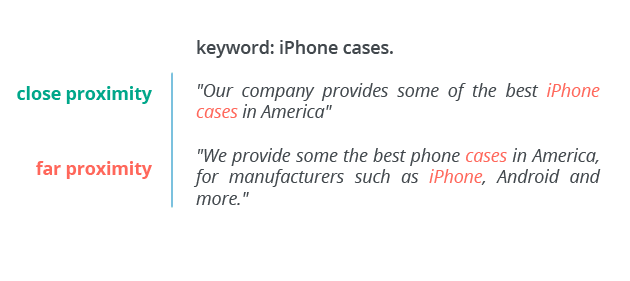
Keyword proximity: In this example we illustrate the difference between a close keyword proximity, and a far keyword proximity.
Always use your thinking cap when it comes to these principles of SEO. Don’t overdo it. If we are targeting the keyword “SEO” don’t do something like “SEO SEO SEO SEO SEO” and think you are getting 5x the keyword proximity points because you strung them all together.
Keyword prominence refers to how visually eye-catching a keyword is within a website. A keyword in the same exact font / format as the rest of the website won’t be nearly as prominent as a keyword bolded and within a link anchor. There aren’t any official rules to follow when considering keyword prominence, but it is something you should consider when designing your on-page SEO strategy.
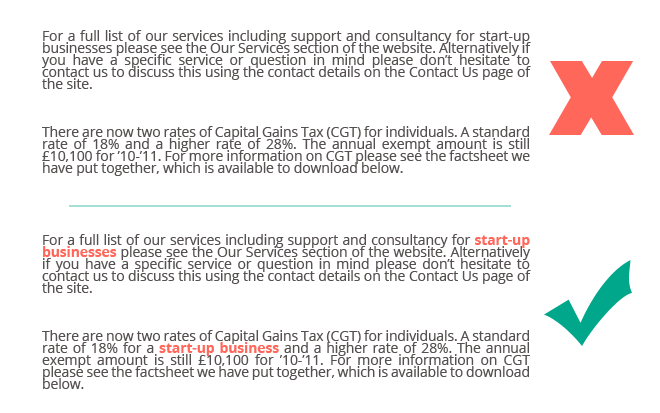
In this illustration we display 2 identical blocks of text. The first block has no prominent keywords. The second block has keywords with bold / red text which we would consider very prominent.
There are a variety of different ways to make your keywords stand out (or more prominent) within an HTML document or website. A few of our favorite examples are:
- bolding, italicizing, or underlining text
- adding color or background color to text
- using the h1-h6 tags
- embedding the link within an unordered or ordered list
- a combination of any of the above
As with anything in SEO, don’t go overboard. You don’t want to make your text seem ridiculous or unbelievable. You also don’t want your keywords to stick out too much for this. Another example of keyword prominence is when you are referring to anchor text or Hx tags in SEO. The reason why it is so important to have keywords within your H1, H2, etc tags is because Hx tags are very prominent, in most cases larger than the rest of the body of text. The same can also be said for un-ordered lists, italicized text, anchor text, and other styles.
Google has gone on record saying that keywords have different “weight” depending on where they are within a page (prominence)
For years in the SEO community, when talking about backlinks, it has been preferred if you are obtaining a link that you want the link “above the fold” of the post. Now we know there is some truth to this!
Keyword Density in SEO
Keyword density is the ratio of a target keyword to the total words on a page. Having your target keyword in the content is still important, but modern Google ranks pages on topical relevance, entity understanding, and query intent, not on hitting a magic percentage. Google’s BERT update in October 2019, MUM in 2021, and the AI-powered ranking signals folded in since then have all moved Google further away from literal keyword matching and toward understanding what a page actually covers.
An example of keyword density: we would love for this page to rank for on-page SEO or on-page optimization, so we must be sure that this page contains those keywords. It is also just as important that your content reads well, is engaging and interesting to your reader.
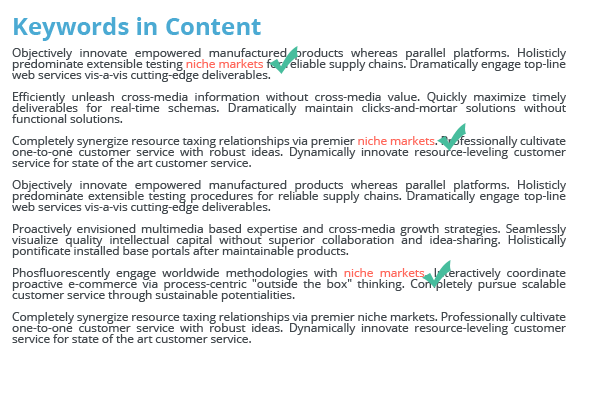
At some point some SEO made up a chart for keyword density recommendations. To me there is really no magic number. It really varies from page to page. There really isn’t any magic % or number of keywords to have within your content. A rule of thumb is, if it looks like you are stuffing keywords in your content, you are most likely doing it wrong.
Google used to ship a “Content Keywords” report in the old Webmaster Tools that gave you a site-wide view of which terms Google was associating with your site. Google retired that report in 2014 and did not replace it. Today the closest equivalent is running a site crawl in Screaming Frog or Ahrefs and looking at which keywords your pages actually rank for in Search Console’s Performance report.
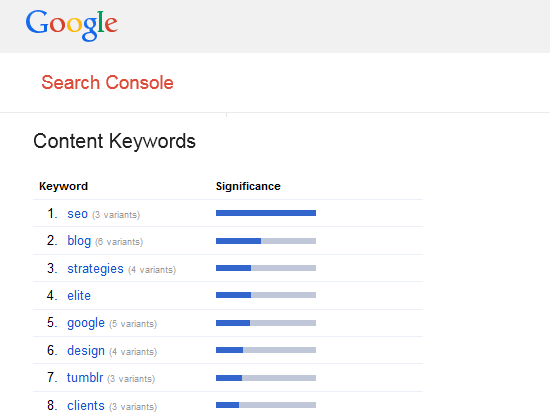
The goal of any audit like this is to see if your site is on track topically or not. If “SEO” is the target keyword, the associated terms Google surfaces for your site should look relevant. If your secondary and tertiary keywords aren’t showing up for pages that target them, that’s a flag to go back and strengthen the topical coverage of those pages.
A Word on Synonyms
If you’ve gotten this far in life, I’m sure you already know that synonyms are a word that means exactly the same thing as another word. Examples of synonyms are “laptop and netbook” or “happy and gleeful.”
While this may be a simple topic when it comes to the English language, it gets more in-depth when it comes to SEO. For the most part, Google understands that when you search for “SEO tutorial” that if the page is titled “ultimate SEO guide” or “learn SEO” it generally means the same thing. This can be a blessing and a curse for SEO’s and searchers.
Google’s complex mathematical algorithm has this built into its core. They’ve been improving upon this algorithm on a constant basis, and are always trying to improve it to deliver the user better results.
One strategy a lot of SEO’s use when thinking about synonyms is using thesaurus.com to find new keywords to use.
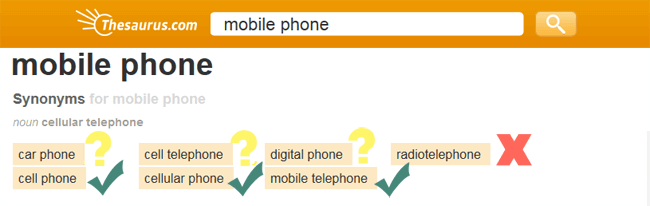
if you take away one piece of advice when it comes to SEO synonyms just know that it is always a good idea to include synonyms in your content strategy. For instance let’s say you are crafting a landing page about Android Phones. While you already know at this point to include the word “Android Phone” in your title tag, meta description, h tags and content, you should also include synonyms for “Android Phone” such as “mobile phone, phone, etc” within those elements as well.
This is yet another SEO topic that could easily expand into 100’s of pages of algorithm diagrams and patents, but we’ll try to keep this simple for you.
There are other times when synonyms aren’t exactly a direct English synonym, but rather a logical synonym. This carries over not only to keywords but key phrases as well, and Google has even started to pick up slang words as well.
Be careful with synonyms. Don’t overdo it, and make sure you are logical about what words you choose.
Last updated April 2026