Meta Description Optimization
Although Google has said in the past that meta descriptions are not a ranking factor, we believe they are still important for SEO. How can this be? Google, as well as other websites and social networks uses the meta description tag in the search engine results preview. So while it may not be a ranking factor, it is still important in the fact that it may affect the click through rate of the search results. Most SEO professionals we know still rewrite metas during every site audit, because while the ranking impact is debatable, the CTR impact is measurable.
The proper format for a meta description is as follows:
In short, while Google may not use meta tags in their ranking factors, they are most definitely still used to classify websites as well as display results about them.
This is why we don’t recommend stuffing too many keywords into your meta description tag. Yes, one or two keywords may help categorize your site appropriately, but it is much more important that your meta description contains compelling copy than anything else.
How Long Should a Meta Description Be?
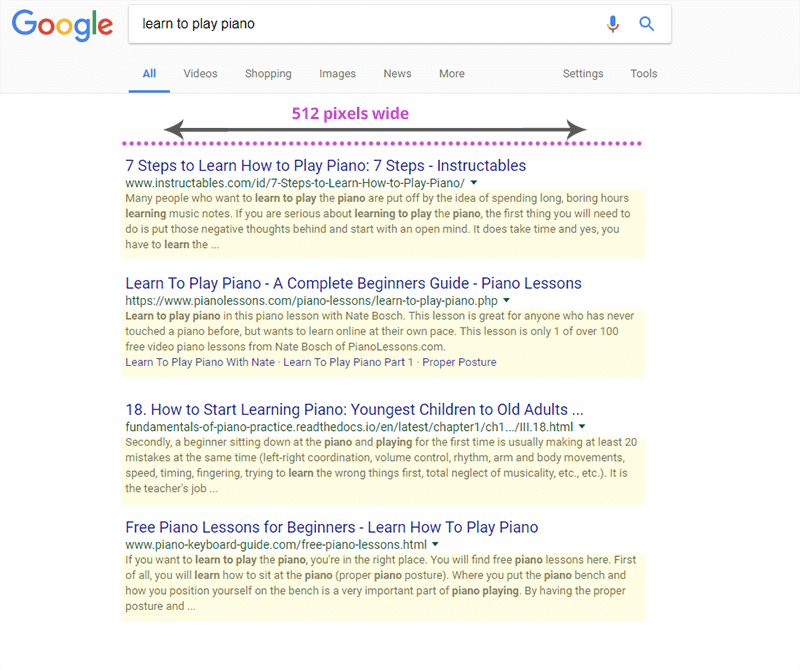
But why did SEOs start measuring meta descriptions and title tags in pixels instead of characters? Character width varies (a capital M is wider than a lowercase i), so two descriptions of the same character count can truncate in different places. In late 2017 Google briefly expanded descriptions to around 300 characters, then quietly rolled it back in mid-2018. Today a safe rule of thumb is 150-160 characters, which roughly corresponds to about 920px on mobile and 990px on desktop before Google cuts the snippet off with an ellipsis.
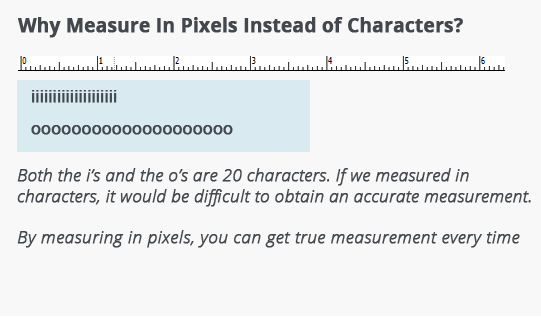
Always remember quality over quantity. You aren’t going to win any special points by filling in the exact amount of pixels or characters for every description. The goal should be writing compelling copy that draws the visitor into your website, not stuffing keywords and getting as close to the maximum as possible.

Google rewrites meta descriptions in the SERPs a lot of the time. Studies have pegged the rewrite rate at well over 60% and it gets higher for long-tail queries, since Google often pulls a snippet from the body copy that more directly matches the search terms. There are also circumstances where Google will ignore your tag entirely: if it is full of spammy keywords, way too long, grammatically broken, or just doesn’t make sense, Google will pull text from somewhere else on the page or show its own snippet. That does not mean the tag is pointless. On branded and head-term queries, your written description is usually the one that runs, so it is still worth writing well.
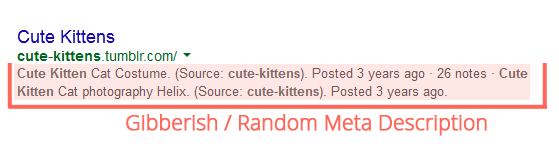
If you forgot to add a meta description to your page, Google might choose one for you, or if they can’t figure out the best description they may just leave it blank. This is inherently bad for CTR and not something you want to do, so fill in your meta descriptions especially for the important pages.
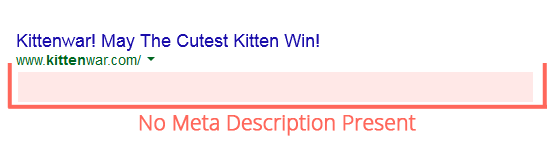
Remember that Google will bold keywords in the description when it matches the users search. This should be a nudge to SEO’s to use relevant and helpful keywords within your meta descriptions, especially for popular keywords.
A Meta Description Bulk Analysis
Over time meta descriptions start to build up, like grimy shower scum. You might have forgotten a few, gotten lazy and written 3 words or accidentally pasted 1000 words into your meta description. It is generally a good idea to do a meta description analysis at least once per quarter or more often for larger websites.
Put it this way, having healthy meta descriptions is so important that if you start to make mistakes Google will warn you about missing or duplicate descriptions in Search Console.
Screaming Frog by far is our favorite tool for SEO analysis in general. One of its best features is analyzing meta descriptions. It is one of the few tools that can give you a comprehensive illustration of your meta-descriptions sitewide within one module.
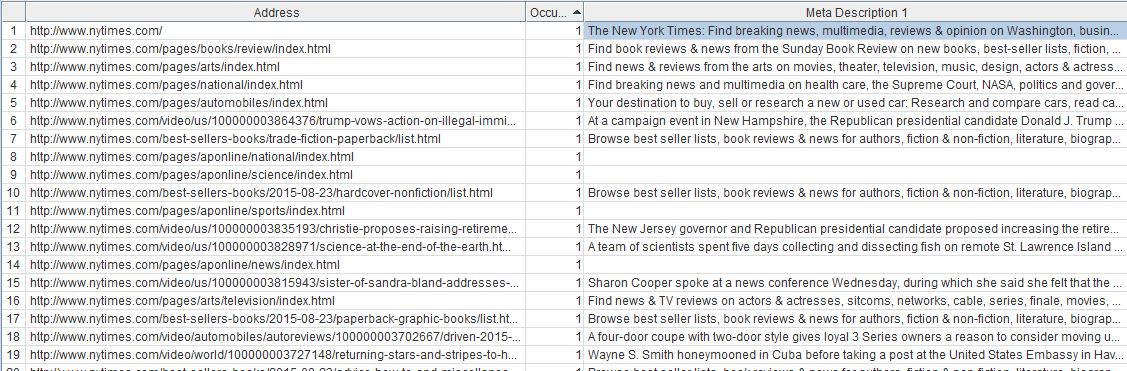
From within Screaming Frog you are also able to filter the results to show only the results that are missing meta descriptions, are too long, too short, or other reasons.
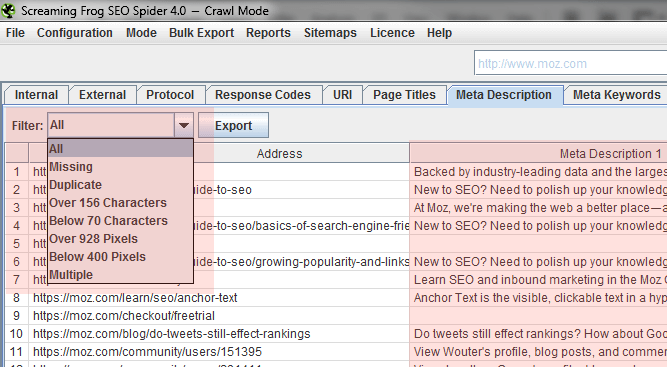
Without Screaming Frog doing a site wide analysis of your meta descriptions could be quite cumbersome.
There are a number of other ways to do a bulk analysis of your meta descriptions. When doing a bulk analysis of your meta descriptions you want to confirm a number of elements:
- size and length of your meta descriptions (target around 150-160 characters)
- content matter of your meta descriptions
- keyword density of your meta descriptions
- content uniqueness
- relevancy
Once you’ve gone through the basics, make sure that all meta descriptions make sense and read well in the search engines. It is one thing to have an optimized meta description but you really want to be sure that these look good and stand out amongst 9 (give or take) search results.
There are a lot of other special tricks that you might pick up along the way. For instance Google tends to cut off descriptions that contain the quote ” symbol.
I know we focused a lot on Google during this section, but Yahoo, Bing as well as other search engines tend to use the meta description tag in their search results. Although their guidelines might vary a bit, the overall rules are the same.