Structured Data and Schema Markup
As a basic definition, there are 3 parts to a website: text, markup, and structured data. Text is the content, markup show the browser how the text should look, and structured data tells bots such as Google what the data is. Structured data can not only make your website look better but it can help search engines categorize your website as well. A lot of times the benefits of structured data aren’t very obvious, but as your understanding of SEO evolves it becomes more evident that it should be an integral part of any SEO plan.
In general search engines want to read and crawl data that is organized (i.e. “structured”) so that they can more efficiently crawl your website. Normal HTML markup can’t be easily read by crawlers. For instance, they can tell that text is big and blue, but they can’t tell that that text is a recipe or a review. With structured data, Google and other crawlers are more easily able to crawl your website and figure out the topical relevancy of your website. It is becoming a very hot topic for SEO’s all over the world, in all industries and almost mandatory for some industries. Schema audits are a fixed line item in our audit deliverables, and we usually find at least one type of structured data that is broken or missing entirely.
Here are some commonly used types of structured data:
- a website
- a blog post
- an article
- an event
- a recipe or a book
- a social media post
- a review
- a song, playlist, or album
- website breadcrumbs
- so much more
In total there are 1000’s of types of schema (people, places and things) from broad topics to ones that are very focused and specific. Some of the really specific ones such as “airline” or “sports organization” don’t really serve a direct purpose when it comes to SEO, but Google is constantly implementing new features so it is always best to mark up as much data as possible.
Defining what your data is from a structured data standpoint can really help search engines tell what your site is, instead of having to guess.
JSON-LD
Microdata and RDFa used to be the default schema formats, but Google has been recommending JSON-LD as the preferred format since around 2015 and it is now the de facto standard. Prior to JSON-LD, SEOs and web developers had to “anchor” schema directly to HTML elements. With JSON-LD you drop a single <script> block anywhere in the page (head, body, or footer), the markup is not visible to users, and you never have to touch your template structure to change or add schema.
But the biggest reason most SEO’s care about JSON-LD or structured data? They want presence in rich results (what Google used to call rich snippets) and in the Knowledge Panel. With the rise of AI Overviews, clean structured data also increases the chance Google’s summaries cite your page rather than a competitor’s. Here is some sample code for JSON-LD recipe I just whipped up:
The end result would ultimately yield a snippet in Google that looks something along the lines of:
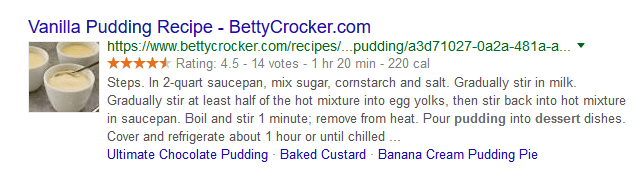
It may seem sometimes that there isn’t a rhyme or reason to how and where Google gives you these snippets. We like to use the method called “close your eyes, and click.”
Facebook Open Graph Protocol
This is where things start to get a bit technical. Structured data has gone from a nice-to-have to a load-bearing piece of modern SEO over the last decade, and with AI Overviews and AI-mode answers pulling heavily from schema, it matters more than ever. For a quick and easy example, we’ll start with Facebook Open Graph Protocol. It might sound complicated, but really all it is is the code required to make a Facebook post look properly formatted.
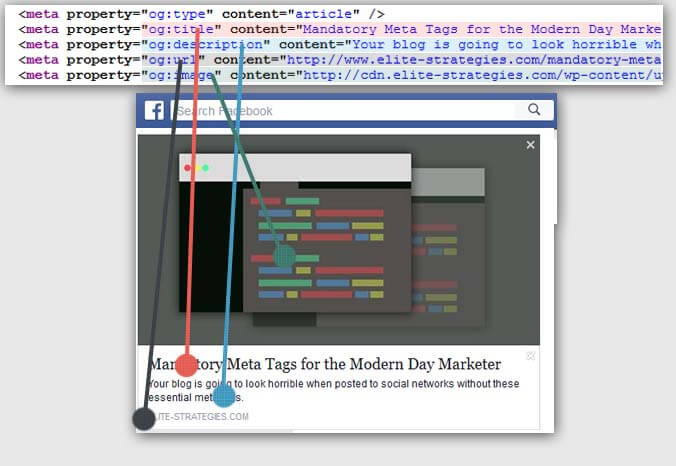
Structured data example. In this image, we illustrate how structured data can help a Facebook post look properly formatted, instead of a small thumbnail and random text.
There are a few more options when it comes to the Facebook Open Graph protocol, but this is the basic info you need to make your posts look swell.
X Cards (formerly Twitter Cards)
Like Open Graph, X Cards (the old “Twitter Cards”, since X’s 2023 rebrand) make your links render as properly formatted cards when shared. X now supports two main card types: summary and summary_large_image. Use summary_large_image if you have a hero image worth showing, otherwise summary is fine.
You might be thinking “I don’t use Twitter, I don’t need this” well keep in mind a few things:
- just because you don’t use X doesn’t mean other people don’t
- no one can see this code
- it won’t hurt you
- it can only help you
With that in mind, it is a general “best practice” to implement this code in any website you are optimizing.
Google’s Knowledge Graph
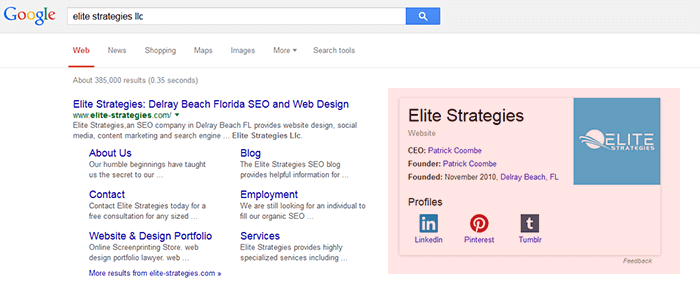
This is one topic that really expands into a subject of its own. Structured data is also one of the aspects that powers Google’s Knowledge Graph. By marking up your content with the proper semantic language, you are helping Google categorize your website. One of the benefits that this might yield is Google rewarding you with a Knowledge Panel within the search results.
Another example of how marking up your content can yield beneficial SEO results is recipes. Remember, SEO stands for search engine optimization and in SEO the goal is not always rankings it is “optimizing” the search engines to the best of your ability. In this case, by marking up a recipe with proper schema markup, Google displays calorie information, reviews as well as cook time in the search results.
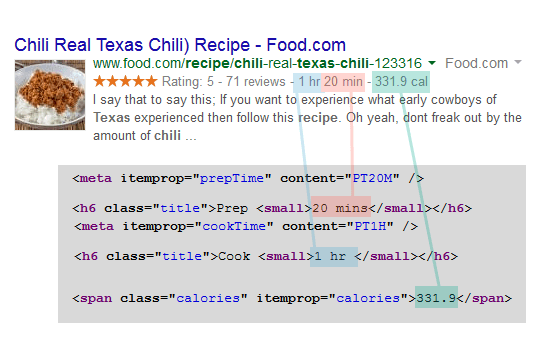
As you can see in the image, the code supplied in the website directly correlates to the search results. Again not all recipes will automatically show up in the search results, it does take some time for Google to figure out who you are but after time it will start to pop. Menus are another hot item in the world of schema markup and structured data. Google “restaurant name menu” and sure enough you’ll probably run across a Google version of the menu right there on Google.
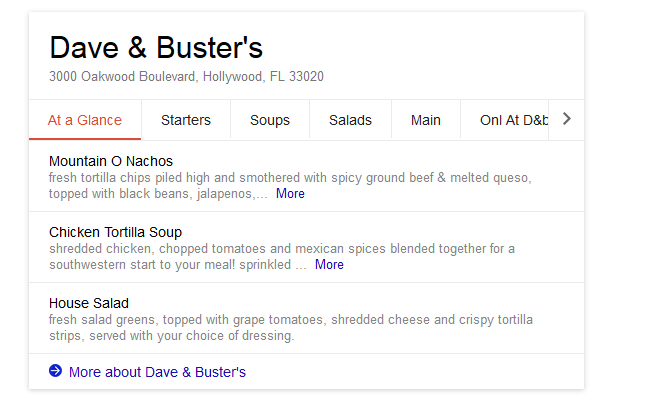
The real kicker here is that sometimes Google will “structure your data” even with no semantic markup present. Google is getting much better at guessing that a menu is a menu or a review is a review. Worth knowing: Google has also pulled some rich result types over time (FAQ rich results were limited to a small set of authoritative sites in August 2023, and HowTo was removed for non-mobile-Android in the same update), so check Google’s current list of supported rich result types before investing heavily in a specific schema.
Testing your Structured Data / Schema Markup
One of the biggest questions we hear about schema markup is “am I doing it right?” We’ll see SEO’s and webmasters working on very complex structured data elements only to find it doesn’t work the way they planned. Google retired the old Structured Data Testing Tool in 2020 and split its job between two replacements: the Rich Results Test, which shows you which rich results your markup is eligible for, and the Schema.org Validator, which validates the markup itself against the schema.org vocabulary. Run both when rolling out new schema.
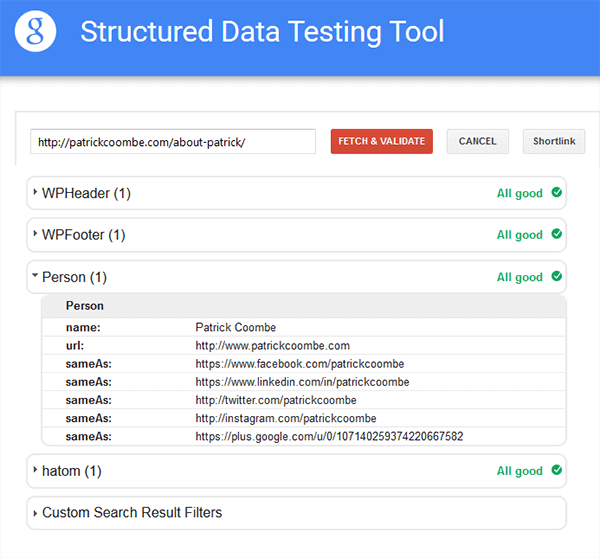
As you can see in the example, there are 4 main sections and individual parameters within each section. In the highlighted section we see the “person” schema markup and the social network profiles linked within. If there were errors, they would be highlighted within them.
One of the useful things about the Rich Results Test is that you can plug in any URL (not just your own) and see what schema another site is using as well. So if you have a new type of markup that you want to play with, you can just plug it into the testing tool and see if it works or not. Of course you can also copy the code directly from the tool, or the source code as well and modify it to suit your needs.
Schema Markup for People
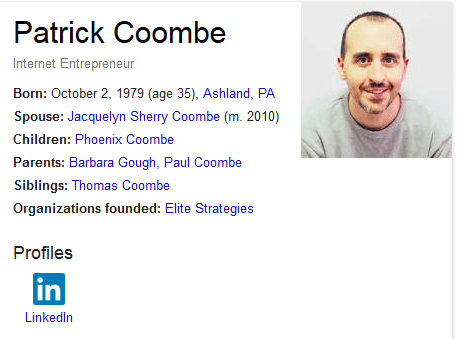
Structuring data for people can be a very rewarding task. Not only will it help search engines find you better but if you have enough authority it can also produce a knowledge graph snippet within the search results. After a few months of testing our CEO Patrick Coombe was able to obtain a Knowledge Panel result using structured data. In his case he used JSON-LD structured data which allows you to embed structured data into your HTML elements without having to modify HTML.
While the code above won’t grant you immediate access into the Knowledge Graph, it will definitely improve your chances. Do a Google search for “Patrick Coombe” and most likely you’ll see some version of this Knowledge Graph:
If you are interested in getting started with structured data, one of the easiest ways to do that is by marking up some of the content on your website. Chances are if you have a smaller website you are not going to break anything.
Other resources:
SEO Skeptic – one of our favorite websites for structured data and SEO in general
SEO by the Sea – without a doubt one of the best resources for SEO patents, structured data and SEO
Rich Results Test and Schema.org Validator – Validate your structured data and check which rich results your markup is eligible for
Last updated April 2026